Peanuts a Golden Celebration the Art and the Story of the Worlds Bestloved Comic Strip
How Moebius revolutionised comic fine art
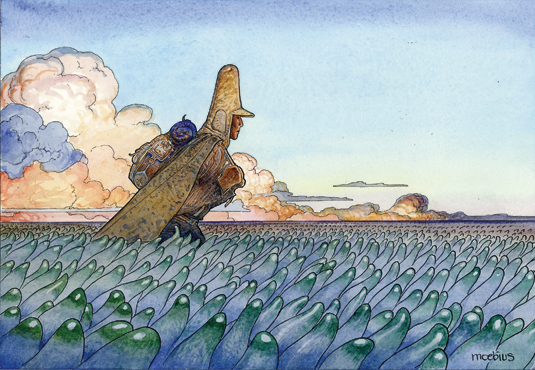
When ImagineFX magazine spoke to the art legend Moebius in 2010, a yr before his death, he looked back at a career of innovation and constant creativity. Here's the interview as information technology was published on 14 December 2010.
Moebius, existent name Jean Giraud, isn't the human being you'd call back he'd be. He'southward an enigma, a fable in France who's ever wanted to be loved abroad for his American comics. He'due south too humble, despite a l-year career that's seen his fine art anchored at the heart of mod sci-fi and fantasy.
Straight and indirectly, he'southward influenced Hollywood'due south greatest picture show-makers, including George Lucas and Ridley Scott. At the age of 22 he pioneered adult graphic novels, taking comics in a new, metaphysical management.
When questioned about his venture from the world of mainstream comic art to that of surreal, often abstract and fantastical illustration, the artist offers a practical observation: "The possibilities as a professional illustrator are very small. Sometimes I prefer to escape and but exercise my own thing – information technology'due south more exciting."

In 1963, as a swain, Jean began working on the Western comic strip Blueberry with Jean-Michel Charlier, the director of French publisher Pilote. Blueberry was a visually realistic and accurate cowboy adventure.
It was also an instant hit with readers. Jean would sign off his art for the episodes every bit 'Gir'. He'd created his beginning pseudonym. Post-obit the death of Jean-Michel Charlier, Jean carried on creating Huckleberry comics (to date, he's written and illustrated 30 volumes).
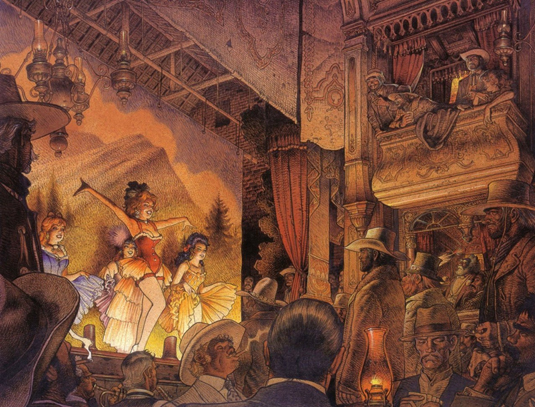
But the artist was yet to get himself. Gir had developed into Jean's signature for comics about adventures and Westerns. "I wanted to do something else," says the creative person, "and then I took a new signature for an artist'due south name: Moebius."
There'southward been a lot written about what the name means. It was reportedly inspired past the Möbius strip, the 2 ends of which fold together to create a one-sided loop. In an official biography, Jean has said, "Going from Giraud to Moebius, I twisted the strip; changed dimensions. I was the same and yet someone else.
I only spent x days on Alien and two months in LA at Disney for Tron
Moebius is the result of my duality." These days, he's more pragmatic, and virtually embarrassed of his past statements: "When I chose the name I was very young: just 22."
"It was an idea with nothing special in listen, a nice name with a good sound and strange flavour. After a time it became interesting because in that location was a lot of background backside the name – mathematics behind the strip."
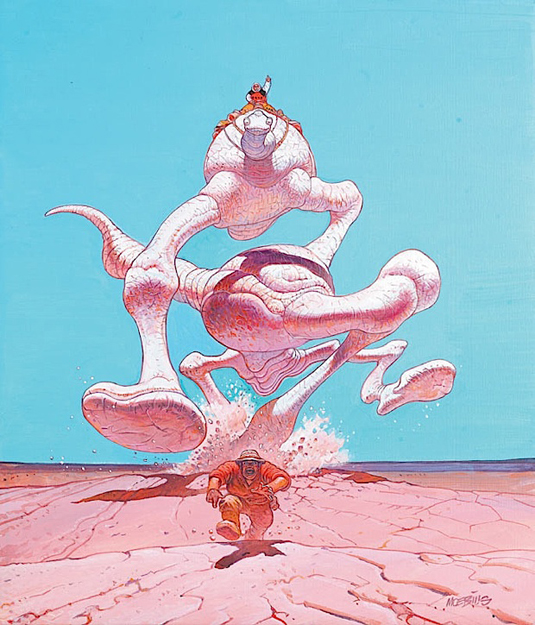
Origins aside, the product of Jean'south alter ego took the comic globe by storm. In 1973, as Moebius, he teamed up with Jean-Pierre Dionnet, Philippe Druillet and Bernard Farkas to create Les Humanoïdes Associés (United Humanoids). The outfit launched Métal Hurlant, later to get Heavy Metal magazine in the United states of america.
As Gir, Jean'due south style was realistic, picking influences from film and photography and basing worlds on real places. Only Moebius was able to explore new environments, developing a rich, detailed style that would bring alien civilisations to life through brilliant, evolving imagery.
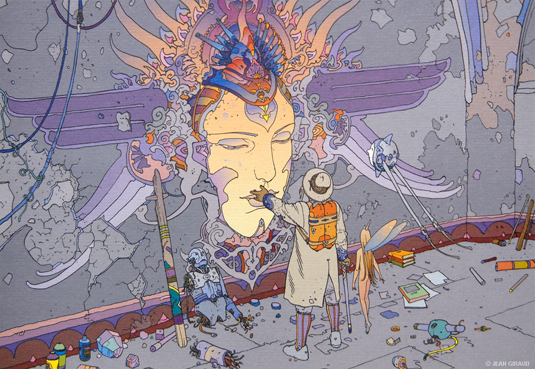
Métal Hurlant and its strips were spurred on by the growing secret printing and comics movement in America in the 70s. "The thought was to be free, completely free, with no boundaries," remembers Jean. "Choosing the subjects, prose and style was costless – my work was sci-fi and fantasy; I wanted to be provocative."
This sense of freedom manifested in pieces such as infinite and time odyssey Le Garage Hermétique (The Airtight Garage), The Long Tomorrow (which influenced Blade Runner) and the fantastical Arzach, a dialogue-free comic following a solitary explorer and his winged alien creature.
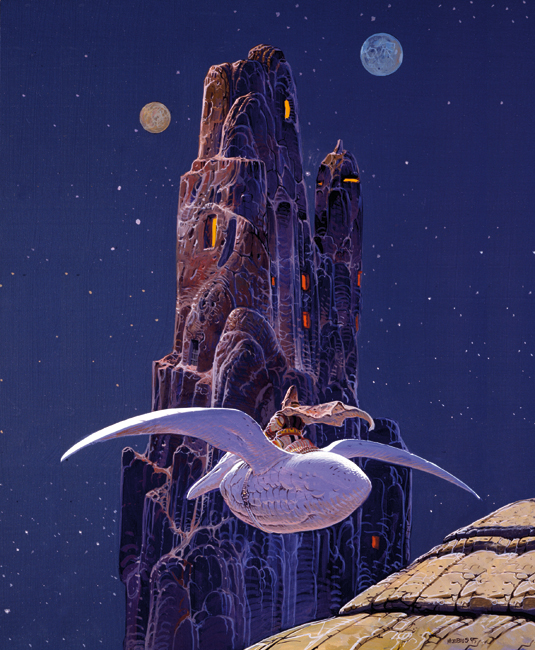
Arzach changed everything. Under the name Moebius, Jean was able to create a new linguistic communication for comics. Freed from the constraints of a conventional script, the strip was a not-linear, expressive and surreal fantasy that asked the reader to class meaning from the images.
Adjacent page: more on Moebius and his art...
Related articles
Source: https://www.creativebloq.com/illustration/how-moebius-revolutionised-comic-art-21514203
0 Response to "Peanuts a Golden Celebration the Art and the Story of the Worlds Bestloved Comic Strip"
Post a Comment